
On… Romantasy
Feeling fruity or falling flat?

“He could have had me right there, on top of the table.”
A Court of Thorns and Roses - Sarah J. Maas
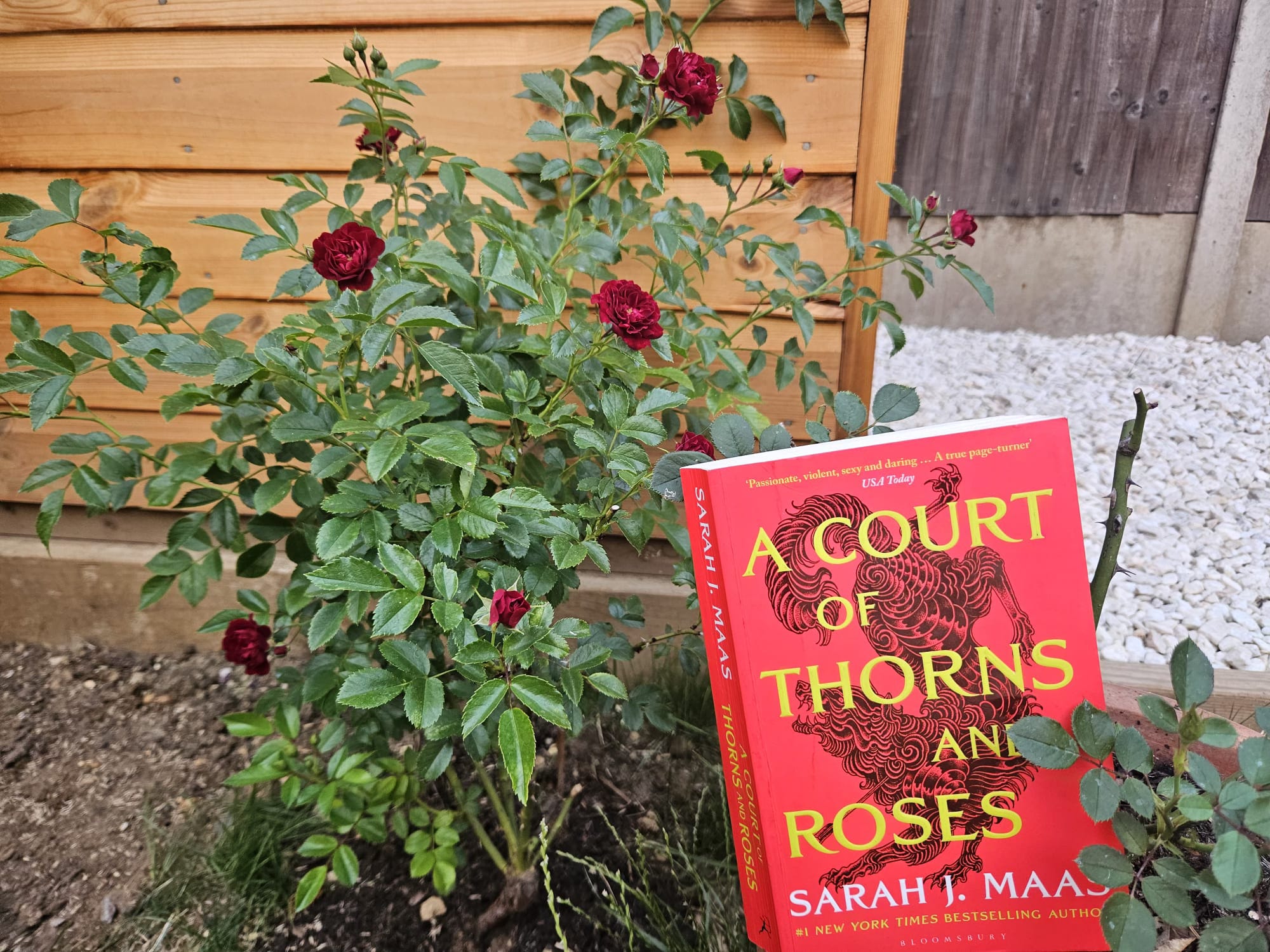
Have you read any romantasy?
Part of my commitment to dominating British literature, and becoming a bookseller par excellence, involves out-reading, out-competing, and generally rubbing my literary knowledge and writing skill in the faces of the posh publishing types who listen to my accent, underestimate me, and assume I’m only there to clean the windows.
So when I learned the UK’s first Romantasy-only bookshop was opening nearby, and having seen the sales figures in The Bookseller, I considered it my duty to dip my toe in the mixed waters of romance and fantasy by actually reading one and popping into the shop.
I chose to read A Court of Thorns and Roses by Sarah J. Maas, the first in a series of novels so successful they’ve got their own acronym. ACOTAR is one of the major drivers of the romantasy phenomenon; a phenomenon that’s not only tipped UK fiction sales above £1bn, but has also created jobs, communities and friendships. Other key authors include Rebecca Yarros (Fourth Wing), Carissa Broadbent (The Serpent and The Wings of Night) and Stephanie Garber (Caraval). Think dragons, faeries, kickass heroines, absolutely ripped love interests with pointy ears, and a sliding scale of smut, labelled ‘spice’, by those in the know.
ACOTAR follows female-lead Feyre (pronounced Fey-ruh) who must save her family and the world, all while being wooed by an impossibly strong and noble half-beast / half-man. She also has to take on a female love-rival, complete Hercules-style challenges, hunt, starve, deal with court intrigues, argue with her sisters, and more than hold her own against friends and foes who are a lot more powerful, and well-fed.
World-building is big part of the romantasy experience and ACOTAR introduces you to seven different lands across islands which more than resemble Britain and Ireland. Readers are expected to learn the differences between faeries, high fae, high lords, Children of the Blessed, something called the Bogge, some shimmering things which I never quite got to the bottom of, and a human-faerie treaty which sounds like all treaties, in that it leaves ordinary people poverty-stricken while massively enriching the upper classes, who look down on the hoi polloi from their enormous palaces and idle wealth, until the problems grow into a likely civil war.
We also learn about magic, which tastes of metal, Fire Nights, and other rituals, and ‘glamours’, which are spells which hide things or people so they are invisible to the naked eye and therefore totally ignored. A bit like saying “it’s about a straight, white, working-class man” to a literary agent/acquiring editor…
… talking of which, let’s discuss the quality of writing.
When I started I wasn’t sure I’d be able to finish. The first few pages are over-written and cliché-ridden to the point of parody. A spine shudders, snow crunches underfoot, a groan is stifled, we have ‘yellow fangs’ and a ‘deafening roar’ and I’m pretty sure we have a ‘blood chilled’ later on as well. We know the main character Feyre is a cross between Cinderella and The Hunger Games’ Katniss, and her family is on the literal breadline*, because Maas hits us over the head with it again and again and again. The family lacks both sustenance and nuance, and the two sisters start off so one-dimensionally ignorant, selfish and spoilt, we’re in no doubt who to sympathise with.
The writing is uneven throughout. Dialogue is exposition-heavy, and the prose is on-the-nose, although occasional flashes of flair flash out from trite paragraphs, often before an impactful single sentence at the end of the chapter brings it back and makes us want to read on. Publishing types like discussing em-dashes almost as much as they like smiling insincerely, and they would have a field day here — there are 13 of them on the page 42/43 spread alone.
I was disappointed in the love interest Tamlin, a ‘high lord’ who I can only imagine as looking a bit like Joe Hart-turned-Zorro-turned-werewolf. He’s got the muscles, he’s got the silent broodiness, he’s got the mask and the world on his shoulders, and he’s got claws that can rip a flimsy dress to shreds, but he hasn’t got the ‘rizz’. I don’t think he cracks a joke once, his clumsy drunken neck biting would lead to a word from HR in the real-world, and his rhyming couplets are woeful. He also lets another man kiss and get a lapdance off his woman while sitting there doing nothing, when we all know any proper romantic lead should be a man’s man who gets stuck in at the slightest provocation.
But there’s plenty to admire here too. The sauce and the story are nicely balanced, slow reveals of motivations and flesh that keep the will-they-won’t-they ticking along nicely; female desire (and sexual history), written in a relatable way, although I’m not quite sure how we’re supposed to feel about the wine-induced sexy dancing, which raises questions of consent. The main character is much more than a pretty, shy virgin waiting for her Prince. She has callused hands, she suffers, breaks bones as well as hearts, and has agency, and complicated feelings about guilt and family. There’s a couple of nice observations too: ‘calf-eyed zealots’ annoying everyone on the High Street, the beautiful black veins on a female mercenary’s leg, the growing complexity of key relationships beyond the love interest.
As a writer, ACOTAR is also a welcome reminder just how propulsive it is to have a main character physically travelling to new locations, especially when adding new characters and new reveals and upping the stakes along the way. It offers a masterclass in how getting ever-closer-but-not-quite-doing-it-yet can drive narrative and tension, regardless of quality at a sentence level, and I like the way literacy-levels are weaved into the plot.
It’s also taught me a bit about comfort-reading; there’s a lot of brushing of hair, hot chocolate, delicious feasts, painting in a massive studio, a glow-up after being bathed by servants… curl-up on the sofa reading that is an aide-memoire that writing offers escapism as well as an opportunity to shoehorn in slurs about Crystal Palace fans (although there’s an under-exploited market for that kind of thing).
There’s a decent dynamic between Feyre and her sister Nesta, which although laid on with a trowel to start off with, develops nicely. There’s another nice scenario between two love interests of sorts – Rhysand and Tamlin – and how women can become victims in the power-play between egotistical men. In this day and age, I’m not so keen on the idea of heroes having servants, or that old cliché about the poor heroine who comes from money and therefore more noble birth (newsflash: you can be poor and noble), plus the old-fashioned need to be made beautiful in a dress before you’re desirable.
But we’re not here for revolution, or experimentation, we’re here for a bit of sexual tension and distraction from the day-to-day, and in that respect, Sarah J. Maas is a writer who knows her reader / audience and she delivers. We’ve got the romantic landscape, the enemies-to-lovers, the life and death stakes, and the opulent palace that provides the perfect backdrop for going at it like knives / a bit of how’s your father / hanky panky etc…
… which all sounds nearly as romantic as a couple of beers stood outside The King’s Arms followed by some tapas at Meson don Felipe and some drunken, fumbled words about being fucking miserable without each other.
I’m glad I read ACOTAR. I’ve learned a lot about an important cultural phenomenon, I can talk to more readers about books and characters which mean an awful lot to them, and I understand the business of publishing a little bit better too. I’ve also been reminded about the nature of entertainment, and it’s made me think again about plot, character, tension, audience, chapter structure, and the reader-experience.
And ACOTAR has made me think about the real world around us, and what women really want. The romantasy shop was packed when I visited, full of women who love these types of books, and these types of love interests. My eyes have been opened.
Apparently women don’t only fancy heavy-drinking, wisecracking Millwall fans who duck responsibility at every turn. They fancy bland, impossibly rich, musclebound hunks as well.
Who’d have thought it?
++ Have you read any romantasy? What should I read next? And if you want to read a truly romantic scene that’s set over a Meson don Felipe crèma catalana, help me get an agent.
*Sample line: “Please get up at dawn to chop that wood.” They also drink hot water because they can’t afford tea. Later on Feyre is given literal bread and water in a prison cell.
- - -
Football and fiction every Friday
In your inbox, free of charge.
Some recent reviews:
- - -
PS: I caught a glimpse.