
On… You Are Here
… and they are far, far ahead

“… because niceness was something that was both rare, and hard to talk about.”
David Nicholls – You Are Here
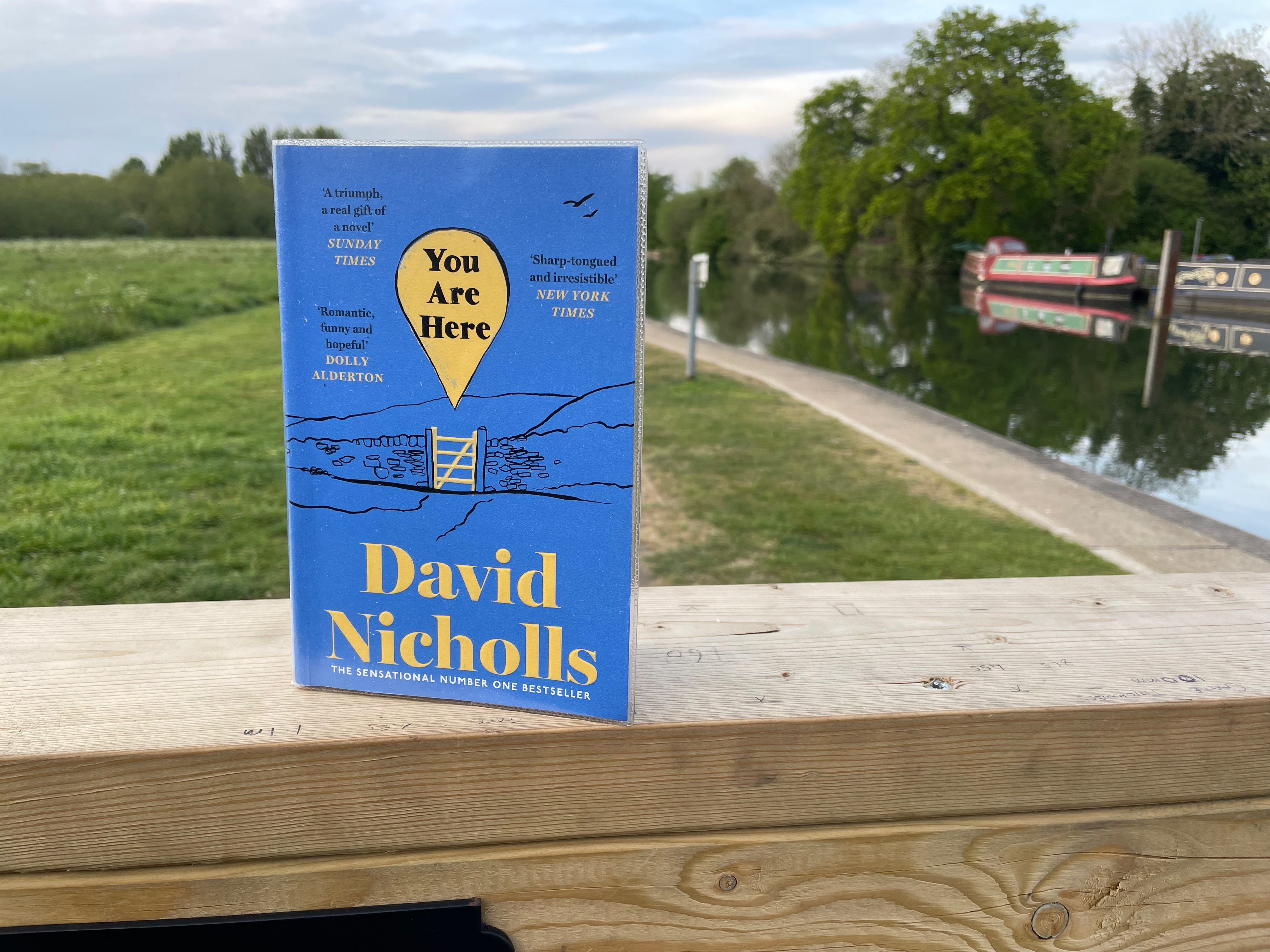
What can you do about David Nicholls?
As an up-and-coming (alright, down-and-diminishing) writer, who can’t get arrested with my first novel, I’ve changed tack, and I’m now trying to think beyond the text and the pitch and instead look to the market, and the competition. I’m trying to identify and learn from those that have made it, are in it, are doing it. What have they got that I haven’t? What do they know? Who do they know? What do they have to say? What’s their ‘secret sauce’, and how does that differ from an idea and paragraphs that excite then alienate pretty much everyone in the industry who see them?
So you go to events, and launches, and recitals, and devour novels by the male British and Irish novelists you spot in The Bookseller and on the shelves. You read Ben Myers, and Benjamin Wood, and Joe Dunthorne and Luke Brown and Ammar Kalia and Shaun Wilson. You read Michael Magee and Will Burns and Oisín McKenna and Tom Newlands and Andrew O’Hagan and plenty more. You shake hands, crack jokes, ask questions. And you observe the way they speak about their work, dress, enunciate, handle the room, and then you look at their paragraphs, and structure, and observations, and rhythm, and verbosity.
It’s a humbling experience. You learn you can’t do style like Threshold, or societal balance like Theft, or timeless decency and dignity like Seascraper, but you think, OK, I can’t compete on that but can any of them do the Dockers Upper and the feisty South London underclass dynamic like I can? And you talk yourself up, and think, okay, I’m not a Premier League writer like them, and my minor characters need some work, and maybe my ‘edge’ is actually just a gigantic chip on the shoulder… but just maybe I can compete in some small way, after all this is a subjective industry and you just need one super-fan, and a niche audience, not a baying mob that could fill Old Trafford…
… and then you see David Nicholls speak at a Curtis Brown Creative New Writers Day, and you read You Are Here, and you think, what is the point, because you are miles, no, galaxies, behind the curve, and no amount of angry-young-man angst and oh-my-God-the-little-bastard-can-actually-write jokes about route one hoofball will ever allow you to catch up with a scribe of such quality, or insight.
You Are Here is outstanding. It’s a novel of great wisdom and great wit, and it captures true courage, which isn’t charging towards a smoking cannon, but tentatively putting yourself back out there when life has chewed you up and spat you out. It follows freelance proofreader Marnie (38), who’s laugh-out-loud one-liners are her first line of defence, and depressive geography teacher Michael (42), whose only solace is solitude and geological specimens that cannot talk – or fight – back.
This unlikely duo is thrust together by their mutual pal Cleo (a note-perfect and well-meaning meddling friend) on a coast-to-coast walk across Britain, battling interior monologues and exterior downpours, at points literally scrabbling towards some unknown destination, or the small comfort of a budget hotel room or forever home.
On both a macro and micro level, You Are Here sings. A delicious framing sees two careworn characters fighting for a new direction in their souls and on an Ordnance Survey map, navigating a wide-open expanse but hemmed in by the looming deadline of the end of the trip. It’s a novel about walking which is exquisitely paced. It has the most wonderful mirroring, the proofreader deliberating first on a novel, and then later, a text message, the geography field trips that reveal more about the teachers than the pupils. Marnie and Michael tackle obstacles in nature and in their hearts. And slowly, ever-so-slowly, a friendship or a romance seems to develop, as the two quite literally reveal themselves a fraction at a time, an exposed calf here, a rolled down stocking there, an admission of vulnerability that is sometimes said, sometimes only hinted at.
The dialogue is to die for — cadence, quality, humour, distinctiveness. The narrative voice is rich with one-sentence observations of such superiority that you’re tempted to put your foot through your laptop screen and go and work in a cocktail bar instead. Consider the way Nicholls weaves in ‘Clapham small plates restaurants’, Marnie’s ‘most pressing commitment was to an open pack of feta…’ the ‘schoolboy’s glance’ and the modest ‘swimming costume you could wear to a funeral’. From the ‘productive coughs like small arms fire’ to the hazelnut yoghurt pot floating in the ice of a budget hotel breakfast buffet, it’s all there, and its far, far better than you can do.
On page 223, there’s a one-sentence paragraph break of such precision you could write a whole blog about it (and I might).
But this is a novel of depth far beyond the sentence level. It’s about love but it’s also about Britain… our landscape, our unique ‘patter’, our sexual and societal mores… pubs with ‘chardonnay’ salt and vinegar crisps, ‘chippies’, and Friday night violence juxtaposed with the decency of the small talk strangers and the friends that help you find your way upon the path. It offers realism without cynicism. There’s no ‘edge’ – Nicholls doesn’t need it. It’s funny, and familiar, but somehow surprising too.
And in Marnie we have a character who may just about out-Bridget Bridget Jones in the way we root for her, pity her, love her as she heads towards a what no doubt will be – and is – tearjerking conclusion.
There’s nothing you can do about David Nicholls. He’s got it. And you haven’t.
So you just sit there and read it. You read it and weep.
++ Have you read David Nicholls? What did you think? And who is streets ahead of everyone else in your line of work?
- - -
Another thing…
Do you remember those kids parties you went to years ago, when one of the other kids would win pass the parcel, and then there’d be another brat who’d complain, so they had another round, and in the end every kid won a prize, and nobody missed out.
Well the social inadequates at Selhurst Park are beside themselves for reaching an also-ran European final. But when you think about the mechanics behind it, getting to that final is not an achievement. It’s a prize for attendance.
- - -