
On… Caravaggio
A light touch, a dark heart

“He had always been an outsider, a troublemaker, a difficult and dangerous man.”
Andrew Graham-Dixon – Caravaggio: A Life Sacred and Profane
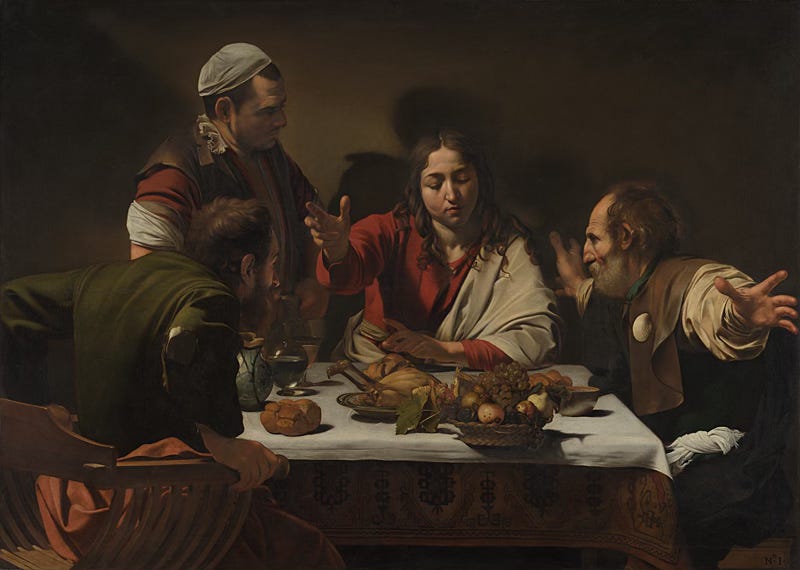
The Supper at Emmaus, 1601, © The National Gallery
What makes a legendary artist? The work? The reputation? Or both?
Caravaggio was a great painter but a man of ill repute. A tortured genius and true original who brought the divine down into the ditches, he was also a killer, a scoundrel, a lout, a rumoured pederast, and the kind of man you really wouldn’t want to lend money to.
Andrew Graham-Dixon’s masterful biography Caravaggio: A Life Sacred and Profane talks us through the full life story of this painter-pariah. Born Michelangelo Merisi of Caravaggio, near Milan, he lost his father and grandfather to the plague on the same day in 1577 when he was just six years old. After an impoverished childhood he became a Milanese painting apprentice, studying Titian, before fleeing (after a quarrel), to Rome, and falling in and out of contracts and into both low and high company; painting altars in churches by day, and then painting the town red in brothels by night.
In Rome, the pattern was set. Lucrative commissions accompanied by professional jealousy, and then pain upon pain; endless arguments, violent altercations, scratching a living, a prison escape, and years on the run before he succumbed to a supposed assassination attempt, which left him disfigured and on death’s door.
Before his death at 38, Caravaggio created some of the best-known and most influential paintings in the western world, but he also killed a man by stabbing him in the groin in a duel, attacked a waiter in a row over buttered artichokes, had a row with an artist he called Johnny Bollock, insulted his paintings and suggested they were good for wiping arses with, verbally abused women and physically attacked men, and was in a gang that was in court for violence and beating someone they labelled a ‘Fucking Grass’. In later life, he fled to Malta, and got into even more bother with the law, necessitating a prison escape from the Knights of St John, before his past caught up with him as he left a pub, and his face was slashed, and body stabbed, and that led to a death soon after, and burial in an unmarked grave.
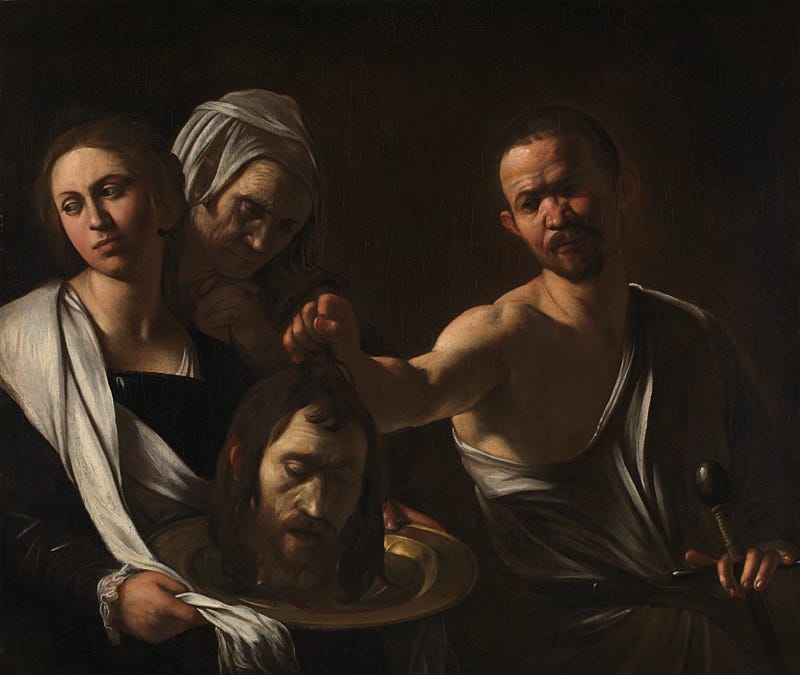
Salome receives the Head of John the Baptist, 1609/10, © The National Gallery
Here was a man who lived on both his wits and his talent (and a few influential well-wishers), and before he died he had pioneered a chiaroscuro style of image that has influenced everyone to Picasso, Pasolini and Martin Scorsese.
His masterworks have survived for almost half a millennium. Often using his young male helper (and rumoured lover) Cecco, and his courtesan acquaintance Fillide, as models, he gravitated from visualising the stories of cardsharps and a gypsy fortune teller, to Greek Gods, miracles, the nativity and the resurrection, but choosing to set these Biblical stories in the everyday lives and locations of the hoi polloi.
His tenebrism style was darkness and more darkness juxtaposed with snatches of often celestial-like lighting, the white penetrating the black to reveal the audacious (at that time) naturalism of the ripped clothes, exhausted bodies and dirt-encrusted feet of the peasant class.
He captured moments; the equivalent of the ‘arrive late, leave early’ storytelling mechanism we’re taught as writers; the instant that Jesus reveals himself at The Supper at Emmaus, the flash of the kiss in The Betrayal of Christ, a snatched glance of pre-concert preparation in The Musicians, the split-second recognition of the formerly-doubting apostle in The Incredulity of Saint Thomas, St Peter’s final breath before his crucifixion cross is erected upside down.
Many of the paintings are in ultra close-up, the zoom lens ramped to extract the maximum emotion, while the cast is cut down to the minimum, single attackers representing the mob. Symbolism is buried in a shadow, the ripeness of the fruit, the decay of the leaf, or even the folds of the cloth. He played with form, most notably with a self-portrait of himself as a beheaded Medusa, captured at the instant of death in a concave style representing Perseus’ shield.
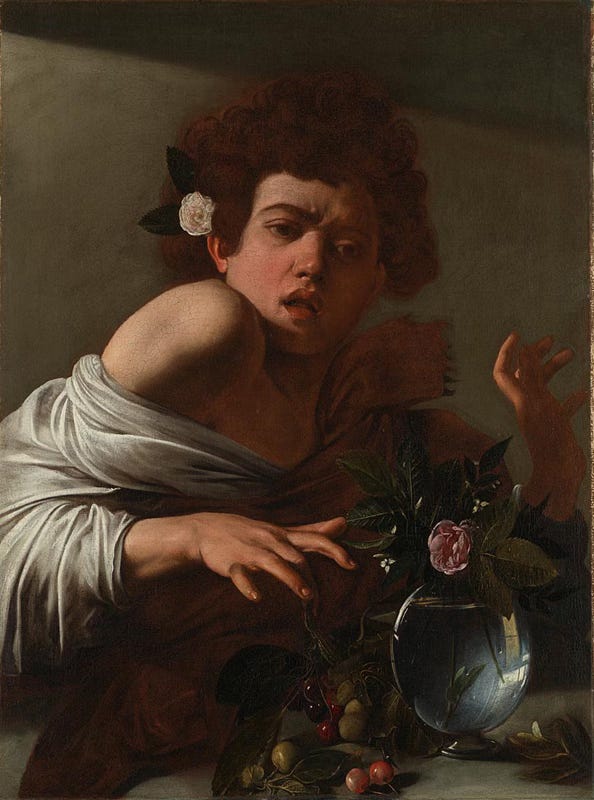
Boy bitten by a Lizard, 1594/5, © The National Gallery
But he did it all while living the life of the poor and less-than-pure he tried to represent. Against convention, he choose realism over perfection and idealism. By bringing drama down to the level of the gutter he brought a new humility and truthful perspective to art, and he showed the poor and illiterate masses God in a way they could relate to and understand. His paintings are known for black and white, but in reality he demonstrated the grey areas of life before the arrival of an angel, or a miracle in close quarters. And on many occasions, Caravaggio quite literally placed himself into his works, adding background self-portraits that showed the toll of the tortures of his life, an intriguing commentary on his own faith, both in himself, and in the divine.
As Graham-Dixon puts it:
“Caravaggio had lived much of his life close to the margins of society, surrounded by poor and ordinary people. He painted them, staging the stories of the Bible with their bodies and their faces. He painted for them, and from their perspective.”
So why should we read about Caravaggio now? He was a nasty man, ripe for cancellation, painting about Gods fewer and fewer people believe in.
I read about him because we’re in an era when the arts are increasingly an upper-class endeavour, populated and orchestrated by out-of-touch types who make it onto social media but never into the squalor.
Caravaggio’s paintings show the power of telling stories for and to the masses, and from their perspectives. He told us the big stories; love, death, revelation, sacrifice, but from outside the bubble. As it is, rather than the idealised versions demanded by the very few who sit at the top.
He spoke to and for the majority.
That’s why he’s lasted five hundred years.
And that is something to aspire to.
++ Which visual artist do you admire the most? Do you reckon you could evade the Knights of St John? And do you know any rich artistic benefactors you could send my way?
Thanks for reading George writes! Subscribe for free to receive new posts and support my work.
- - -
I’m looking forward to…
A few books on my radar for the months ahead:
Louise Kennedy - Stations
Tom Newlands - Something Like Happiness
Josh Holton - Fledgling
… and of course the next Bond continuation novel, King Zero, by Charlie Higson.
- - -
How you can help…
Restack, like, and comment on these posts. Subscribe (it’s free) and share links amongst your friends.
I’m counting on you. Spread the word…
- - -
A few older posts you might enjoy:
- - -
PS: Last Nite.